

AUTHOR DETAILS
NAME: SUHA TARAFDAR
SURENDRANATH LAW COLLEGE
1ST YEAR,1ST SEM
Introduction
The law is traditionally thought of as a shield protecting rights, limiting power, and resolving conflict
through reason rather than force. However, history demonstrates time and again that law can also be a
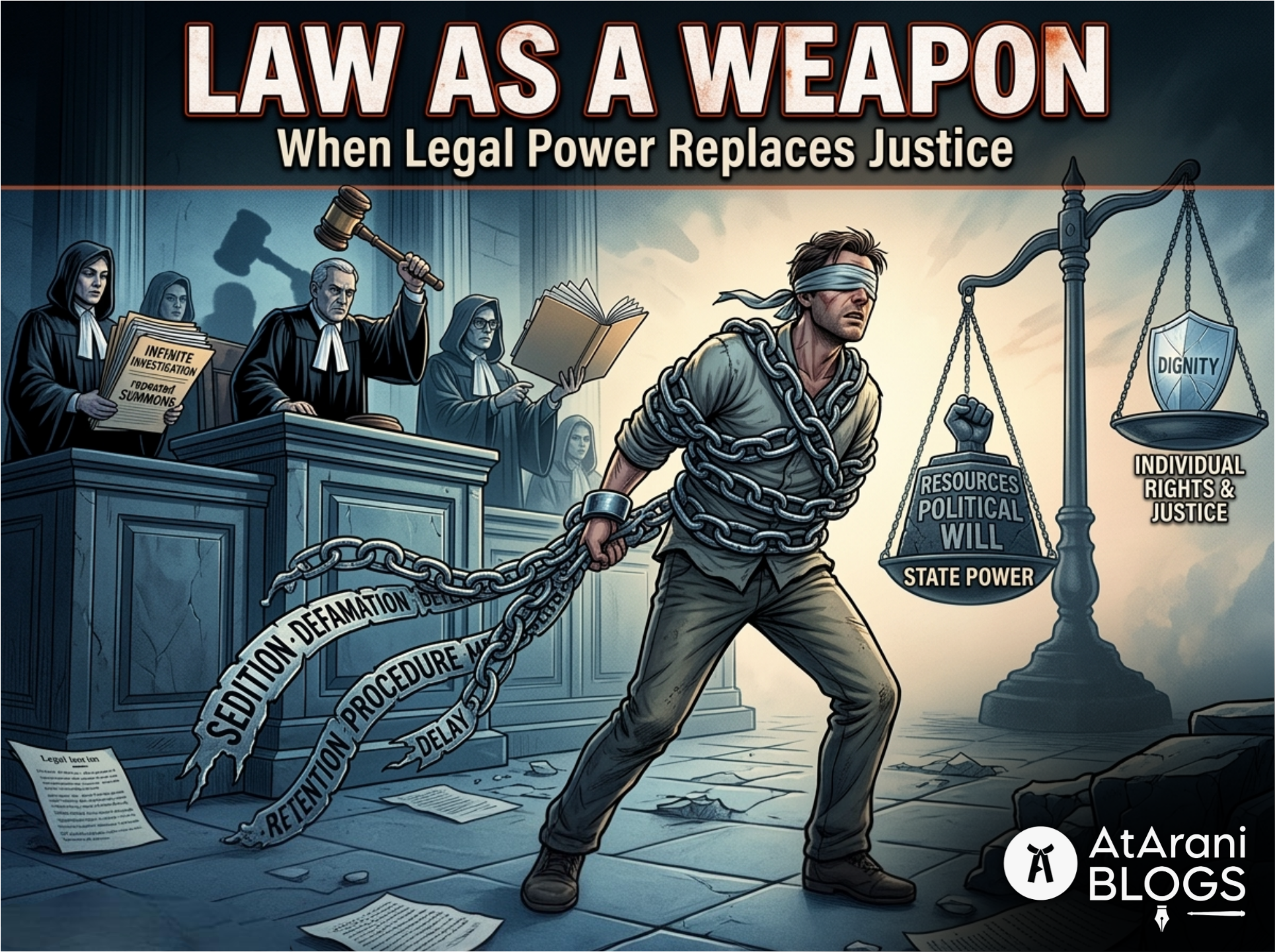
weapon. When legal systems are used in a strategic manner to intimidate, silence, delay, or exhaust
adversaries, the law itself becomes an instrument of oppression rather than justice. This occurs not in
defiance of the rule of law but through it.
This whole thing with lawfare, its basically using the legal system in a misusing manner to control
people politically or socially, especially in places that are supposed to be democratic1.the essay is
looking at how various laws get twisted against folks who speak out or belong to groups on the
margins. Even though everything looks legal on the surface, it messes with actual justice and makes
democracy seem defective.
Further it will conclude by suggesting the establishment of a Justice Abuse Review Mechanism
(JARM) to prevent the weaponization of the law while maintaining judicial independence.
Defining the Disruption and the Actors Involved
The disruption is not in the lack of law but in its hyper-presence. Laws involving sedition,terrorism, or
defamation are frequently used not to establish guilt. Instead it is often misused to harass individuals.
Arrests without expeditious trials, open-ended investigations, and repeated summons make procedure
a tool for coercion, rendering conviction unnecessary.
These actors are generally the authorities of the State, such as the police, prosecutors, and political
leaders, often under informal political control, and sometimes with additional support from the private
or economic sector. Judicial independence is formal, but the site of punishment is more and more the
condition of delay, confusion, and proceduralist difficulty rather than adjudicative determination. The
most impacted are those who resist the established power systems,that includes journalists, activists,
opposition leaders, minorities, and whistleblowers. As a result, the law becomes a tool of controlling
the dissent while superficially being within the law.
The most effective settings for the abuse of legal power are characterized by legal complexity, lengthy
legal decision-making processes, and a liberal degree of discretion on the part of legal authorities. In a
setting where there is a dense and complicated system of law and the relevant processes are often
lengthy and extend over a period of years, it is a prohibitively costly process to be on the receiving
end of legal action. Any process of initiating action through the registering of a case, serving of
summons, or beginning of investigation is relatively straightforward. The duration and finality of
settlement, however, are long-drawn, indeterminate, and extremely costly.
How Law Amplifies or Constrains Power
The weaponization of law also creates a level of asymmetricity. In other words, for the state and other
powerful individuals, there is no real marginal cost for initiating lawsuits. No further proof of guilt is
needed, and there is a low level of personal or institutional risk. Conversely, for those being accused,
there is a potentially dire personal and financial cost for being accused. Not only can financial ruin,
personal dignity, emotional well-being, or physical imprisonment result, but even winning does not
help heal past wounds. The damage is irreversible.
Years spent in the legal system serve as a deterrent against dissent. This creates a chilling effect,
where citizens practice self-censorship not because speech is prohibited, but because the defense of
legality is simply too costly.
This is a strange equation in which the passage of years spent in the legal system acts as a deterrent to
political opposition. Time spent in the courts is a self-censoring influence, not because speaking out is
actively forbidden, but because defending oneself in court is prohibitively expensive. The fear is not a
fear of being found guilty, but a fear of being in the legal system.
However, the exercise of such legal power in the above manner possesses an internal contradiction. If
the rule of law is conceived as a strategic device, then the idea of legal legitimacy would begin to
crumble. The legal institutions may continue to survive, but the feeling of trust would start to decline
as the idea of justice would begin to look discriminatory. Ultimately, the very idea of placing
dependence upon the rule of law as the foundation for the exercise of power would start to question
the viability of such legitimacy.
Ethical, Social, and Democratic Risks
The abuse of law creates three interlocking risks.
First, it corrodes substantive justice. The rule of law, which holds that punishment follows conviction,
is turned on its head. Process becomes punishment. This offends all notions of justice and proportion.
Second, it corrupts democratic competition5. When opposition voices are mired in never-ending
litigation, elections and public discourse are no longer fair contests of ideas but lopsided contests,
where the opposition is disadvantaged by legal harassment.
Third, this kind of thing makes people cynical about the whole system. Not just the government, but
justice itself. Trust fades away. Law starts feeling like something to fear, not protection. People pull
back, or they might even turn to breaking rules themselves.
A Bold, Forward-Looking Institutional Solution
To fix some of this, there could be something like the Justice Abuse Review Mechanism,JARM [The proposed Justice Abuse Review Mechanism (JARM) draws conceptual inspiration from existing oversight bodies for prosecutorial misconduct and judicial review of abuse of process, such as sanctions for malicious
prosecution in common law jurisdictions (e.g., abuse of process tort elements in U.S. law, Cornell Legal
Information Institute).] for short,an independent mechanism to check for abuse. The group running it would include former judges, experts on the constitution, people from civil
society, and ex-prosecutors. They get picked through some bipartisan deal to keep it fair.
JARM would not decide if someone is guilty. That stays with the courts. Instead, it looks at if
processes are being twisted, like through too much delay or repeating stuff unnecessarily, or just being
way out of proportion.
They would put out annual reports on patterns of abuse. But nothing that messes with active trials.
This setup keeps judges independent. At the same time, it tries to balance power back toward
individual rights. It seems like a step, anyway.
Counsel Expedited Trials
This will help JARM recommend or initiate court orders to fast-track cases that have been labeled as
abusive, ensuring day-to-day hearings, tight time limits, and few adjournments to dispose of such
cases quickly. In the Indian context, the Supreme Court has often referred to the right to a speedy trial
under Article 21 (for instance, in recent advisories to High Courts to give priority to UAPA cases
pending for over five years with day-to-day hearings or to release on bail those whose trials are stuck
indefinitely under laws such as PMLA/UAPA)7. Thus, JARM repudiates “process as punishment” in
sedition/UAPA cases, where activists or journalists are subjected to pretrial detention for years
without any progress8, to prevent indefinite harassment and restore the balance of individual rights
without compromising judicial autonomy.
Assess cost sanctions for abusive or malicious prosecution
JARM may assess abuse and recommend or assist in applications for financial punishment, such as
requiring prosecutors or complainants to pay the accused’s legal costs, court fees, or compensatory
damages for abuse of process.Sanctions of this kind are already operational in the Indian judiciary for
frivolous/vexatious litigation (as in inherent powers or tort of malicious prosecution, as evident in awards such as Rs. 50 lakhs to ISRO scientist Nambi Narayanan10 for false espionage charges or directives for compensation in wrongful prosecution reports by the Law Commission of India. This
goes a long way in preventing the misuse of law by powerful individuals for frivolous or politically
motivated litigation, as the cost of delay is highly asymmetric—minimal for the state and catastrophic
for the individual.
Require periodic judicial justification for continued prosecution
This mechanism would require periodic (say, every 6-12 months) assessments wherein prosecutors are
required to submit fresh justifications for continued prosecution in terms of new evidence, reasons for
delay, or justification for continued prosecution in the interests of justice, failing which courts may
dismiss, expedite, or impose a remedy. Based on Supreme Court monitoring in long-pending cases (as
in directions for monitoring arrears, prioritizing old cases, or bail on grounds of delay under Article
21), this would prevent “zombie” prosecutions that remain as tools of control, as evident in UAPA
detentions for long periods without commencing trials.
Conclusion
Preventing this from occurring demands institutional creativity, not legal destructivism. Initiatives
such as the Justice Abuse Review Mechanism recognize a hard truth that the mere legality of the law
does not in itself ensure justice. The real danger to law is not when it is missing. It is when it gets
abused on purpose. Legal systems turn into weapons. Justice gets pushed off, watered down, or
handed out only to some. What is left is just the outside shell of rule of law. It looks the same but
means nothing inside.Legality by itself does not guarantee justice. I might be oversimplifying, but it feels like without
accountability and keeping things in proportion, plus being open about it, the law cannot really protect
dignity. It just becomes a tool for whoever holds power.
In the end, a strong legal system shows how it protects opponents, not in punishing enemies well.