

Author Information
Name: Kankana Dhar.
College: Jogesh Chandra Chaudhuri Law College.
Year: 2nd Year.
Semester: 3rd Semester.
Introduction
Law plays a vital role in every civilised society by regulating conduct, resolving disputes, and safeguarding individual rights. Its legitimacy rests on fairness, impartiality, and equal application. When law operates within these parameters, it functions as a protector of liberty and social order. However, when legal provisions are exploited to serve the ill motives of powerful individuals or institutions, law loses its moral authority and becomes an instrument of oppression rather than protection.
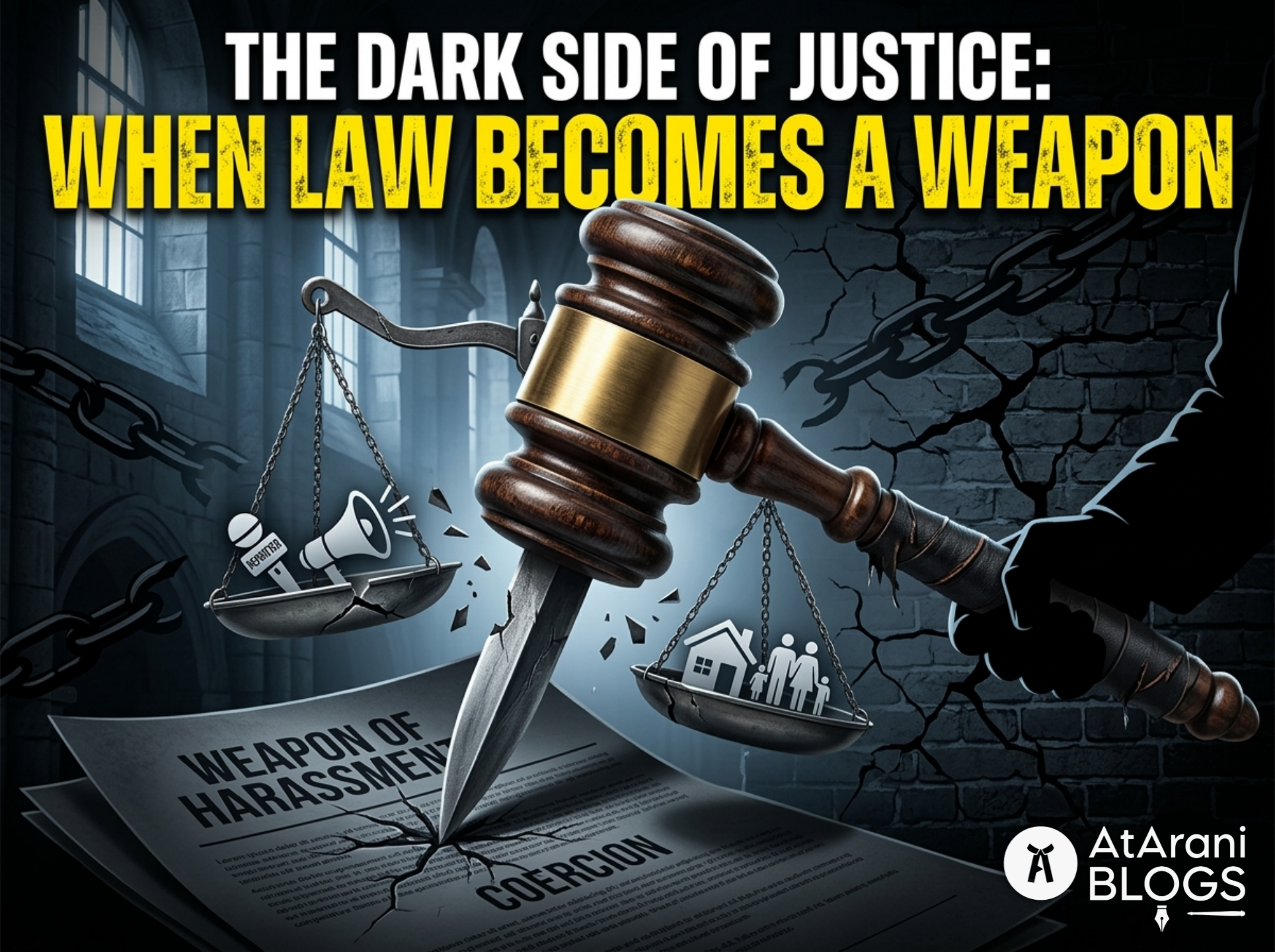
In recent years, increasing concern has been expressed over the misuse of legal provisions by individuals, institutions, and even the State. Legal processes, which are inherently coercive in nature, are often employed as tools of intimidation, harassment, and retaliation. This phenomenon, commonly referred to as the weaponisation of law, poses a serious threat to the integrity of the justice system and undermines the foundational principle of the rule of law.
Conceptual Framework: Misuse of Law
Misuse of law refers to the deliberate and strategic invocation of legal provisions in bad faith, with the primary intention of causing harm rather than securing justice. Unlike legitimate legal action, misuse is characterised by malice, absence of a genuine grievance, and disproportionate use of legal machinery. The objective is not redressal but intimidation, delay, or coercion.
The coercive power of law—manifested through arrest, prosecution, attachment of property, or prolonged litigation—renders it particularly vulnerable to abuse. Even where proceedings ultimately end in acquittal or dismissal, the legal process itself often becomes a form of punishment. This inversion of justice defeats the very purpose for which law exists.
Forms of Weaponisation of Law
One of the most common forms of misuse is false and frivolous litigation. Such cases are often initiated to harass opponents, delay justice, or extract settlements. The financial burden of legal fees, repeated court appearances, and social stigma places the accused in a position of severe disadvantage, regardless of the merits of the case.
Another significant manifestation is the misuse of protective legislations. Laws enacted to protect vulnerable sections of society serve an essential social function. However, their misuse through false allegations undermines their credibility and diverts attention from genuine victims, thereby weakening the efficacy of such protections.
Abuse of state power constitutes a particularly grave form of misuse. Arbitrary arrests, selective prosecution, and excessive reliance on preventive detention laws can convert law into a tool of political or administrative oppression. When enforcement agencies act with bias or ulterior motives, legal power is weaponised against dissent and democratic freedoms.
A more recent manifestation is the rise of Strategic Lawsuits Against Public Participation (SLAPPs). These lawsuits are initiated to silence journalists, activists, whistle-blowers, or critics by subjecting them to expensive and prolonged litigation. Even in the absence of substantive merit, such actions create a chilling effect on free speech and public discourse.
Causes Behind the Misuse of Law
The misuse of law arises from multiple systemic and social factors. These include lack of legal awareness, inordinate delays in the justice delivery system, inadequate penalties for malicious litigation, and excessive discretionary powers vested in authorities. Structural inequalities and power imbalances further enable dominant groups to exploit legal mechanisms against weaker sections of society.
Impact on Justice and the Rule of Law
The weaponisation of law erodes public confidence in the justice system and burdens courts with unnecessary litigation. Judicial resources are diverted from genuine disputes, resulting in further delays and inefficiency. Most critically, misuse of law violates the fundamental principle that law must function as a protector of rights rather than a persecutor of individuals.
Judicial Response and Safeguards
Indian courts have consistently recognised the dangers posed by misuse of law and have emphasised caution in invoking coercive legal powers. The judiciary has advocated strict scrutiny of complaints, protection of personal liberty, and imposition of costs to deter frivolous litigation.
In State of Haryana v. Bhajan Lal (1992), the Supreme Court laid down illustrative categories under which criminal proceedings may be quashed under Article 226 of the Constitution or Section 482 of the Code of Criminal Procedure,
1973 (now Section 528 of the Bharatiya Nagarik Suraksha Sanhita, 2023). The Court expressly acknowledged that criminal law should not be used for ulterior motives and that proceedings initiated maliciously constitute an abuse of process.
Similarly, in Arnesh Kumar v. State of Bihar (2014), the Supreme Court addressed routine misuse of arrest powers, particularly in offences punishable with imprisonment up to seven years. The Court issued binding guidelines restraining automatic arrests and emphasised compliance with Sections 41 and 41A of the CrPC (Sections 35 and 36 in the new Bharatiya Nagarik Suraksha Sanhita (BNSS), 2023), reaffirming that arrest is preventive and not punitive, and that misuse violates Article 21 of the Constitution.
Judicial scrutiny has also extended to the misuse of protective laws. In Rajesh Sharma v. State of Uttar Pradesh (2017), the Supreme Court observed that Section 498A IPC (Section 85 of the Bharatiya Nyaya Sanhita (BNS), 2023) was sometimes used as a “weapon rather than a shield.” Although certain directions were modified in Social Action Forum for Manav Adhikar v. Union of India (2018), the Court reaffirmed the need to prevent misuse without diluting legislative intent.
In Subrata Roy Sahara v. Union of India (2014), the Supreme Court stressed the importance of imposing exemplary costs to deter vexatious litigation. Likewise, in Kartar Singh v. State of Punjab (1994), while examining the validity of TADA (Terrorist and Disruptive Activities (Prevention) Act), the Court cautioned against misuse of stringent laws and emphasised procedural safeguards.
Statutory safeguards such as Section 250 of the CrPC (has been superseded by the Bharatiya Nagarik Suraksha Sanhita (BNSS), 2023) and Section 35A of the Code of Civil Procedure, 1908 further empower courts to award compensation for false or vexatious proceedings. Through these measures, Indian courts have sought to balance prevention of misuse with protection of genuine litigants.
Preventive Measures and the Way Forward
While judicial safeguards play a crucial role, long-term prevention of misuse requires structural and procedural reforms. Consistent imposition of realistic and proportionate costs for malicious litigation can deter abuse and compensate victims of legal harassment. Courts must also exercise rigorous scrutiny at the threshold stage before permitting coercive measures.
Institutional accountability of enforcement agencies is equally essential. Discretionary powers must be exercised in accordance with constitutional principles of fairness and proportionality, supported by training, sensitisation, and effective disciplinary mechanisms.
Judicial delays further incentivise misuse by converting the process into punishment. Expeditious disposal of cases and promotion of alternative dispute resolution mechanisms can significantly reduce opportunities for harassment through prolonged litigation.
Conclusion
The misuse of law poses a serious threat to the legitimacy of the justice system and the foundational principles of the rule of law. When legal mechanisms are employed as tools of coercion rather than justice, law ceases to protect and begins to oppress. Indian courts have demonstrated sustained vigilance in addressing this problem and have evolved safeguards to curb abuse without undermining genuine legal protections.
However, judicial intervention alone is insufficient. A balanced framework— combining vigilant adjudication, accountable enforcement, procedural discipline, and legal awareness—is essential to ensure that law remains a shield for the vulnerable rather than a weapon for the powerful. Ultimately, the strength of the legal system lies not in the severity of its provisions but in the integrity and good faith with which they are applied.