

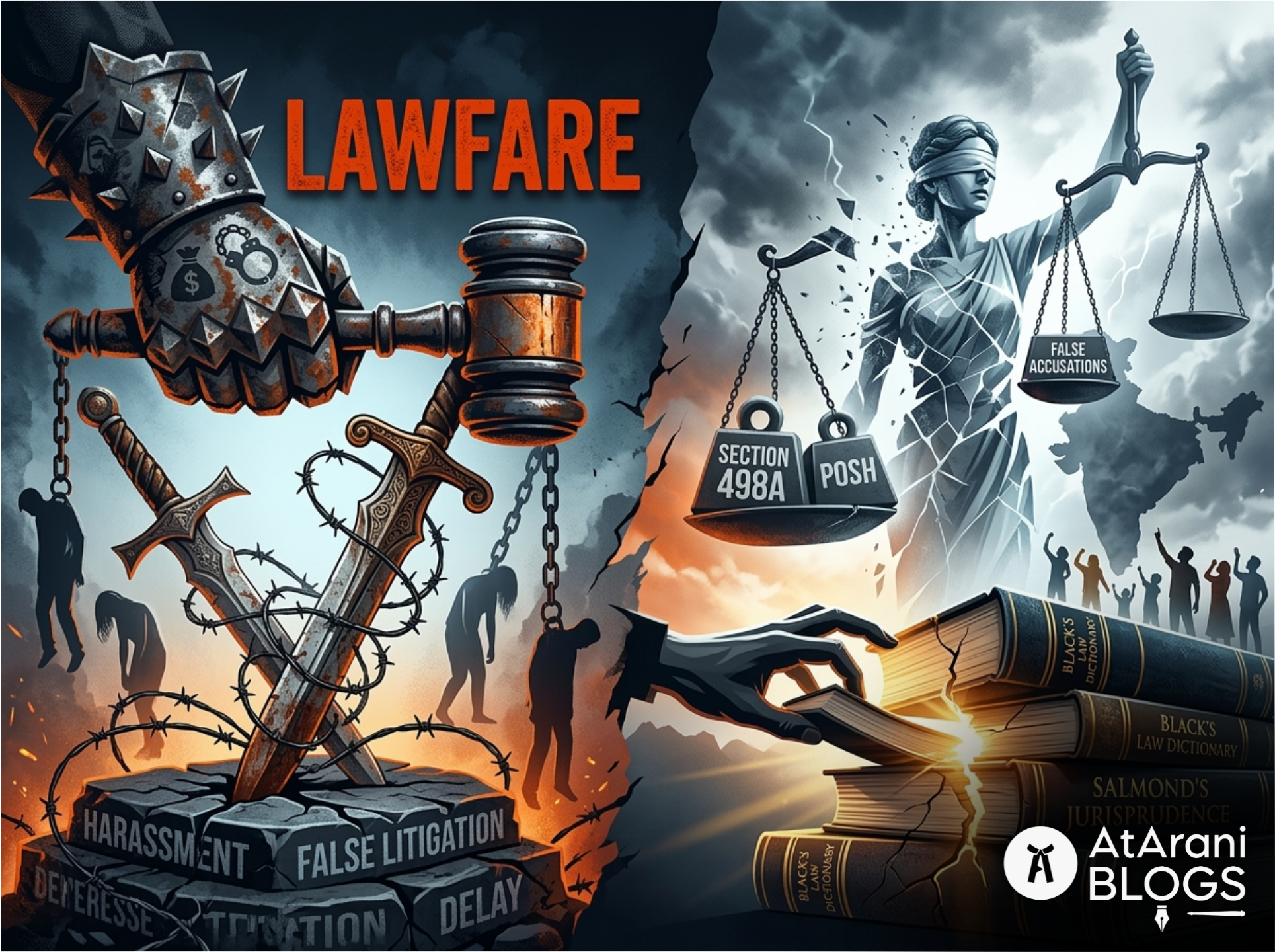
LAW AS A MISUSING WEAPON
An article written by Saranya Guha Mallick, Shyambazar Law College (2nd Year), University of Calcutta
INTRODUCTION
In recent years, the misuse of law in India has emerged as a significant concern. Law is a word that means different things at different times. According to Black’s Law Dictionary law is “a body of rules of action or conduct prescribed by controlling authority, and having binding legal force. That which must be obeyed and followed by citizens subject to sanctions or legal consequence is a law.” Everyone has their own interpretation about law. According to Salmond , the law may be defined as “A body of principles recognised and applied by the state in the administration of justice”. Law is one of the most crucial tools for social control and it is fundamental to society. It maintains social order, it protects individual rights, resolves disputes, and establishes moral standards. While law works as a shield to protect the rights of people and to maintain justice in society, sometimes it becomes a two-edged sword. Nowadays in our society law is misused in various ways. Th1S misuse not only harms individuals but also slowly destroys public faith in the legal system.
Various Ways in which Law becomes a weapon :-
The mam aim of Law is to provide Justice. The law turns into a weapon when legal systems, institutions, and doctrines are manipulated to achieve political, or economic objectives, rather than to deliver justice. Misusing law as a weapon is termed “lawfare” , it means using legal systems to harass, intimidate, or destroy opponents rather than achieve justice. General Charles Dunlap Jr. formally defined “lawfare” in 2001 as “the use of law as a weapon of war,” he also popularized this term
Commonly misused legal provisions are often those that were originally enacted to protect vulnerable sections of society. However, when such laws are exploited for personal motives, they disturb social harmony and create serious legal imbalances. Misuse of these provisions leads to harassment of innocent persons and undermines the true purpose of the law.
Some of the common ways are as follows:-
1) FALSE LITIGATION:-
Nowadays false litigation is a significant issue in the Indian legal system. These cases do not have any genuine merit and are often filed with mala fide intentions to settle personal, financial, or political matters . In this way the legal process itself can become a form of punishment for innocent persons because of the lengthy court proceedings, repeated adjournments, and heavy legal costs. Frivolous cases waste precious judicial time and resources and create delay in the hearing of genuine cases. Defendants often face immense mental agony and financial exhaustion, sometimes leading to the ruin of reputations.
Indian courts have taken some strict stance against these abuses such as :-
- Courts now impose exemplary costs on litigants for filing baseless petitions. Punjab and Haryana High Court and the Supreme Court have recently imposed costs of Rs 50,000 to Rs 25 Lakhs for abusing the court process.
- Section 482 of the Code of Criminal Procedure (CrPC) can be used by High courts to quash FIRS that are clearly malicious, unsubstantiated, and filed for harassment.
- Tamil Nadu Vexatious Litigation (Prevention) Act, 1949, requires habitual litigants to seek court permission before filing new cases.
Victims of malicious prosecution can file a civil suit for damages to recover costs and for compensation for mental agony.
2) MISUSE OF CRIMINAL LAW:-
Nowadays, criminal law provisions are wrongly applied to matters that are purely civil in nature. This is done to pressurize the opposite party by creating fear of arrest and police action. The misuse of criminal law in civil matters is often termed as “dressing up” a civil dispute in criminal garb . In the case of Madhushree Datta v. State of Karnataka (2025) The Supreme Court of India quashed the case, identifying it as a deliberate attempt to reclassify non-cognizable civil grievances into criminal offences to harass the accused.
In the case of State of Haryana v. Bhajan Lal , the guidelines for High Courts to use their inherent powers (Section 482 CrPC/Section 528 BNSS) to quash proceedings that are manifestly attended with mala fide intent was provided
3) INTENTIONAL PROLONGING OF LITIGATION
There is a legal maxim that “justice delayed is justice denied”. This idiom was put forward by former British Statesman and Prime Minister William E Gladstone, in the late 1800s. Over time, the meaning of this phrase has been spoken in many different ways. Sometimes disposal of cases takes years and years which is the most important weak point of the whole judicial system and a way of using law as a misusing weapon. Martin Luther King had quoted a statement that ‘Injustice anywhere is a threat to justice everywhere.’ Thus, Justice should be impartial, cheap, and speedy . It is ultimately a failure of social justice, when a Mother files suits and after her death her great grandson or daughter gets the relief, this delay is equal to denial of justice. If timely justice is not provided, then the Justice loses its importance and violates the concept of social justice.
The main cause of delay in civil litigation is the complex procedure of the Civil Procedure Code, 1908.
The number of pending cases in India is growing at an alarming rate every day . India has one of the largest number of pending court cases in the world. In January 2026, the total number of pending cases of all types and at all levels rose above 54 million, including over 180,000 court cases pending for more than 30 years in district and high courts . According to a 2018 Niti Aayog strategy paper, it would take more than 324 years to clear the backlog.
Delay invites a lot of problems and prolongs pendency of cases causes serious repercussions on the public. An effective, fair and expedient trial is the fundamental right of every citizen. The
Supreme Court in recent years by invoking Article 21 have tried to give some relief to people in this regard. There are various examples such as –
Mahanadi Coal Fields Ltd. vs. Mathias Oram (2022) The Supreme Court noted that land acquisition victims from tribal communities were fighting for compensation since 1988, this delay was a direct denial of justice.
Uphaar Cinema Fire Case (1997 – 2015)” In this incident 59 people died due to fire, the legal battle for justice lasted 18 years. The owners of the cinema hall used procedural delays to avoid punishment which led to a verdict that was seen as too little, too late.
Thus in this way powerful parties take advantage of repeated adjournments, appeals, and procedural loopholes to prolong cases. This strategy exhausts the weaker party financially and mentally, allowing the powerful to outlast them and defeat justice
4) THE PARADOX OF PROTECTION –
While our legislature has drafted “social welfare legislation” to heal deep rooted violence against women and to protect marginalized or vulnerable groups , they are diverted from their original purpose. Instead of serving as a shield for the weak, they are sharpened into a weapon for personal or financial gain.
Specific allegations against husband’s relatives and Misuse of Section 498-A
Section 498-A of IPC seeks to protect women from cruelty by the husband and his family, but considering the current trends, it raises important questions about its application and potential misuse. In a recent Supreme Court judgment on Section 498-A misuse, the Court said, “a mere reference to the names of family members in a criminal case arising out of a matrimonial dispute, without specific allegations indicating their active involvement should be nipped in the bud. ‘
In the recent case of Dara Lakshmi Narayana v. State of Telangana, The Supreme Court quashed criminal proceedings under Section 498A IPC and Sections 3 and 4 of the Dowry Prohibition Act. It noted that the allegations lacked specific instances of cruelty or dowry demands, and merely naming family members without concrete evidence amounts to abuse of legal process.
Also in Archin Gupta v. State of Haryana (2025), the Supreme Court held that Section 498A IPC should not be applied mechanically. The Court observed that minor marital issues were often exaggerated by the wife’s family which led to misuse of police machinery to harass the husband. The Court stated that, “many times, the parents including the close relatives of the wife make a mountain out of a mole. Instead of salvaging the situation and making all possible endeavours to save the marriage, their action either due to ignorance or on account of sheer hatred towards the husband and his family members, brings about complete destruction of marriage on trivial issues. The first thing that comes in the mind of the wife, her parents and her relatives is the Police, as if the Police is the panacea of all evil”
According to National Crime Records Bureau data, in 2012 nearly 200,000 people were arrested on unproven dowry allegations, with only 15% of the accused convicted . Recently, a Public interest Litigation (PIL) was filed in the Supreme Court (SC) after a techie’s suicide in Bengaluru, seeking intervention to review and reform dowry and domestic violence laws. The plea stated that Dowry Prohibition Act, 1961 and Section 498A of the Indian Penal Code (now Bharatiya Nyaya Sanhita) has been misused to settle unrelated disputes and suppress the husband’s family.
The POSH Act (2013) & Professional Retaliation
The Sexual Harassment of Women at Workplace (Prevention, Prohibition and Redressal) Act, 2013 , known as the POSH Act, is a critical legal framework designed to ensure safe, equitable workplaces. But sometimes the protection envisaged under the POSH Act is being misused and abused by women, however the statute has a remedy for the same as the POSH Act includes a specific provision for punishing the complainant for filing of the false or malicious complaint. The same has been observed by the Hon ‘ble High Courts in India as stated below: Anita Suresh Vs Union of India & Others, [2] The Hon’ble High Court of Delhi has dismissed a writ petition filed by the complainant and has passed an order directing the petitioner/complainant to pay a fine of INR 50,000 for filing a false complaint and misusing the provisions of the POSH Act.
Section 375 (Rape) of IPC
Under Section 375 of the IPC [1], only men can be perpetrators and women victims of rape. The section does not recognize men and transgenders as rape victims. Section 377 of IPC is the only option for male victims, but it faces challenges and does not classify male-on-male sexual assault as rape.
Public Interest Litigation (PIL)
Public Interest Litigation (PIL) was born from the heart of Justice P.N. Bhagwati to give a voice to the poor, but today, it is often used by those who already have a very loud voice. In many recent cases, PILS are filed to settle political scores or corporate rivalries. The goal isn’t to win the case; the goal is to get an “Injunction” (a stay order) that stops work for years, causing massive financial loss to the opponent. In the case of Khimjibhai Patadia v. State of Maharashtra & Ors. (2024) The Court didn’t just dismiss the case, it imposed Exemplary Costs of Lakhs on the petitioner. The judge remarked, “The judicial clock is expensive. Every minute wasted on a publicity stunt is a minute stolen from a citizen waiting for actual justice.
CONCLUSION
In conclusion, Law is a very powerful force in society. When it is used properly, it helps in delivering justice but when it is misused, it can turn into a tool of oppression and cause harm instead of justice. The answer is not reducing laws, but ensuring their fair implementation, strong judicial supervision, legal awareness among people, and ethical conduct by legal professionals. Law should always remain a source of hope for the oppressed, not a weapon in the hands of the powerful.
BIBLIOGRAPHY
Table of Cases
- Achin Gupta v. State of Haryana, (2024) INSC 369.
- Anita Suresh v. Union oflndia & ors., W.P. (C) 5114/2015 (Delhi High court).
- Dara Lakshmi Narayana v. State ofTe1angana, (2024) INSC 953.
- Khimjibhai Harjivanbhai Patadia v. State of Maharashtra & Ors., (2024) Bombay High Court.
- Madhushree Datta v. State of Karnataka, (2025) Supreme Court of India.
- Mahanadi Coal Fields Ltd. v. Mathias (ham, (2022) 11 SCC 334. State ofHaryana v. Bhajan Lai, (1992) supp (1) SCC 335.
Statutes & Legislations
- The Bharatiya Nyaya Sanhita (BNS), 2023 (Formerly Indian Penal code).
- The Bharatiya Nagarik Suraksha Sanhita (BNSS), 2023 (Formerly Code of Criminal Procedure).
- The Code of Civil Procedure (CPC), 1908.
- The Dowry Prohibition Act, 1961.
- The Sexual Harassment of Women at Workplace (Prevention, Prohibition and Redressal) Act, 2013.
Reports & References
- Black’s Law Dictionary, 1 Ith Edition.
- Dunlap, C. J., Jr. (2001). Law and Military Interventions. Harvard University.
- National Crime Records Bureau (NCRB), Annual Reports (2012-2025).
- NITI Aayog Strategy Paper, 2018.